

Living the Internet of Agents: My OpenClaw Experience
I recently installed OpenClaw.ai on a spare home mini-computer I had lying around. After the usual round of dependency wrestling and configuration tweaks, something became clear:
AI agents are the new infrastructure
I had already experimented with agents before OpenClaw. I built CareerStack, a personal knowledge agent grounded exclusively in my professional background. It was intentionally constrained: answer questions about my career without hallucinating or straying beyond curated source material. The full implementation is documented here.
What I didn’t expect was how quickly a theoretical concept I’d written about the Internet of Agents would turn into something tangible and running in my own home.
This post reflects on how that ecosystem emerged, what it reveals about agent-based architectures, and why I’m re-thinking the Internet of Agents.
Revisiting the Internet of Agents
In my earlier post, Internet of Agents, I argued that AI is following the same path as early enterprise software: vertically siloed domains built around specific industries like financial services, healthcare, and SaaS.
Those systems shared common characteristics:
- Centralized intelligence constrained by data gravity
- Strong governance and compliance boundaries
- Deep specialization for narrowly defined roles
- Explicit, well-defined interfaces between components
AI is following a similar trajectory. Early systems are monolithic-single, large models handling everything from retrieval to reasoning to execution.
But the pressure to decompose is already visible.
Why route a simple lookup through a reasoning-heavy model when a specialized retrieval agent can respond in milliseconds at a fraction of the cost?
The same forces that drove us from monoliths to microservices are now pushing us from monolithic models to agent-based architectures:
- Composability
- Specialization
- Economic efficiency
Just as networking separated control planes from data planes, AI systems are beginning to separate reasoning planes from execution planes.
The shift isn’t about replacing models. It’s about structuring intelligence more efficiently.
Knowledge Agents vs Execution Agents
CareerStack was my first concrete implementation of these ideas.
Architecturally, it had clear requirements:
- Economical (Cloudflare R2 + vector retrieval keeps costs negligible)
- Customizable (complete control over branding and UX)
- Observable (full visibility into logs, costs, and usage)
- Bounded (strictly limited to curated professional content)
It uses retrieval-augmented generation (RAG), enforces scope constraints, and acts more like a service appliance than a chatbot.
Its job is simple:
Answer questions. Stay grounded. Do not act.
OpenClaw represents an entirely different class of system.
While CareerStack retrieves and reasons, OpenClaw executes. It interacts with local resources, monitors state, triggers workflows, and can take action on hardware it directly controls.
The “aha” moment wasn’t that OpenClaw could chat.
It was realizing that OpenClaw is an autonomous runtime. It’s infrastructure.
Its architecture can be distilled into a simple loop:
Time → Events → Queue → Agent → State
Note: I recommend watching Damian Galarza’s YouTube video to learn more about OpenClaw’s Architecture (https://youtu.be/CAbrRTu5xcw?si=gho-xkxKCnEYKaTd)
It continuously processes multiple input types:
- Messages - direct user interaction
- Heartbeats - time-based triggers that make the system initiate actions
- Crons - scheduled precision events
- Hooks & Webhooks - internal and external state changes
- Agent-to-Agent Messaging - coordination across domains
This persistent event loop creates the illusion of sentience. In reality, it’s disciplined state management combined with structured orchestration.
That distinction matters.
CareerStack answers questions. OpenClaw takes action.
Together, they represent two complementary but independent agent classes:
| Agent Type | Scope | Authority | Risk Profile |
|---|---|---|---|
| Knowledge Agent | Bounded | Informational | Low |
| Execution Agent | Expanding | Operational | High |
This separation is architectural-not philosophical.
Security Is Not Theoretical
Autonomy introduces risk.
Because OpenClaw requires deep system access, its risk profile is materially different from a cloud-hosted chatbot. Community-contributed skills can introduce vulnerabilities. Cisco’s security research found that 26% of available community skills contain vulnerabilities.
That reality reinforces an important operational principle:
Run execution agents with isolation and restraint.
My approach:
- Deploy on a secondary machine
- Use isolated user accounts
- Strictly limit loaded skills
- Monitor logs continuously
- Treat it like infrastructure, not a toy
Enterprises move slower here because they must. Personal systems move faster because they can.
That difference will shape how the Internet of Agents evolves.
A Three-Agent Runtime
One of the first lessons was that generalist agents become brittle quickly. Authority expands faster than safety boundaries.
Instead of building a single omniscient assistant, I decomposed responsibilities into three specialized agents-each isolated by workspace, communication channel, and domain authority.
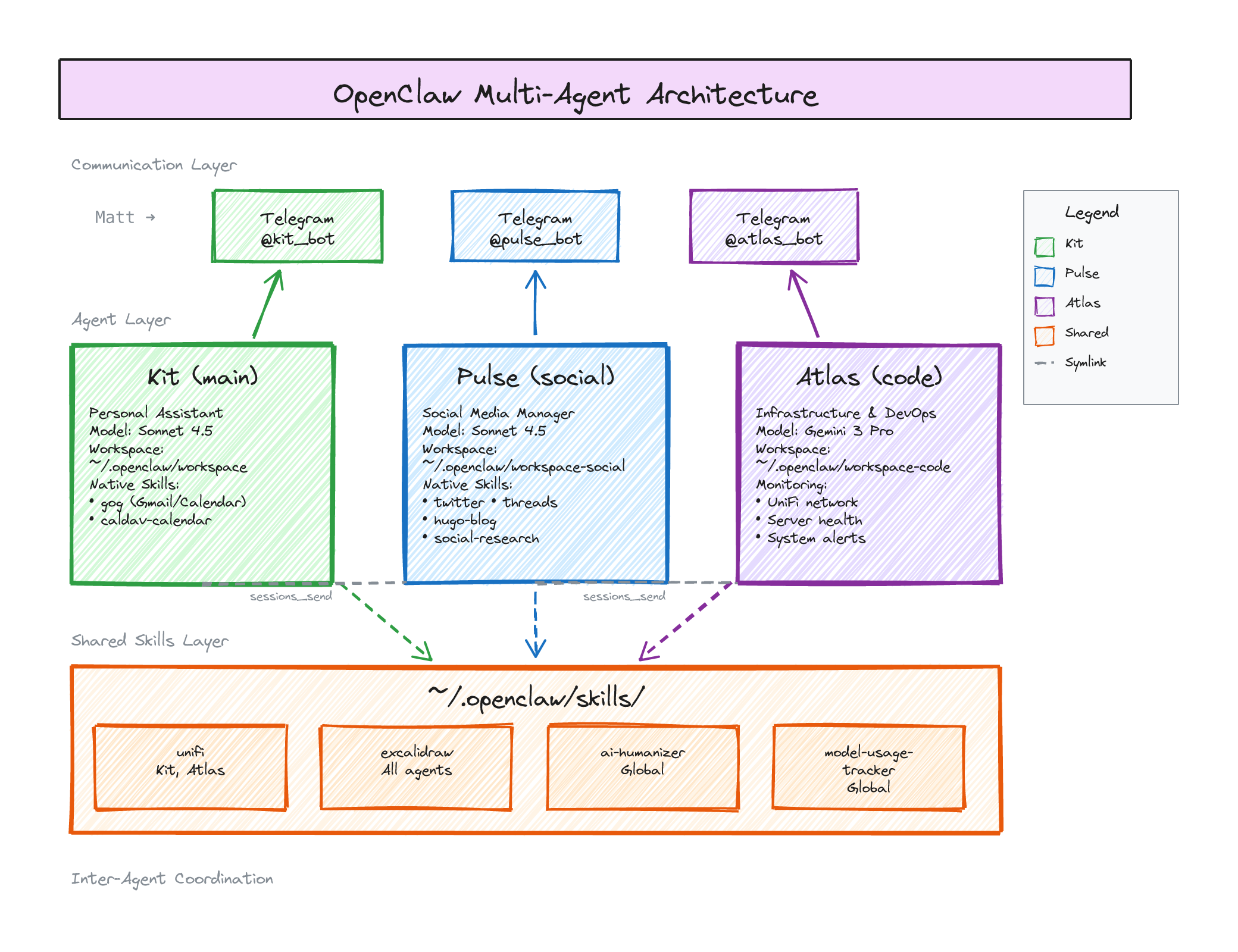
- Kit (main) - Personal assistant handling Gmail, calendar, daily operations
- Pulse (social) - Social media and content creation workflows
- Atlas (code) - Infrastructure monitoring, Coding and DevOps tasks
Each agent runs in an isolated workspace with symlinked access to a shared skills directory (~/.openclaw/skills/). This Unix-native approach avoids the overhead of service meshes or API gateways. It’s simple filesystem-level composition.
Atlas uses a different model than the others. Model uniformity isn’t a requirement-task suitability is. Routing by cost, latency, and domain complexity becomes a practical decision rather than a philosophical one.
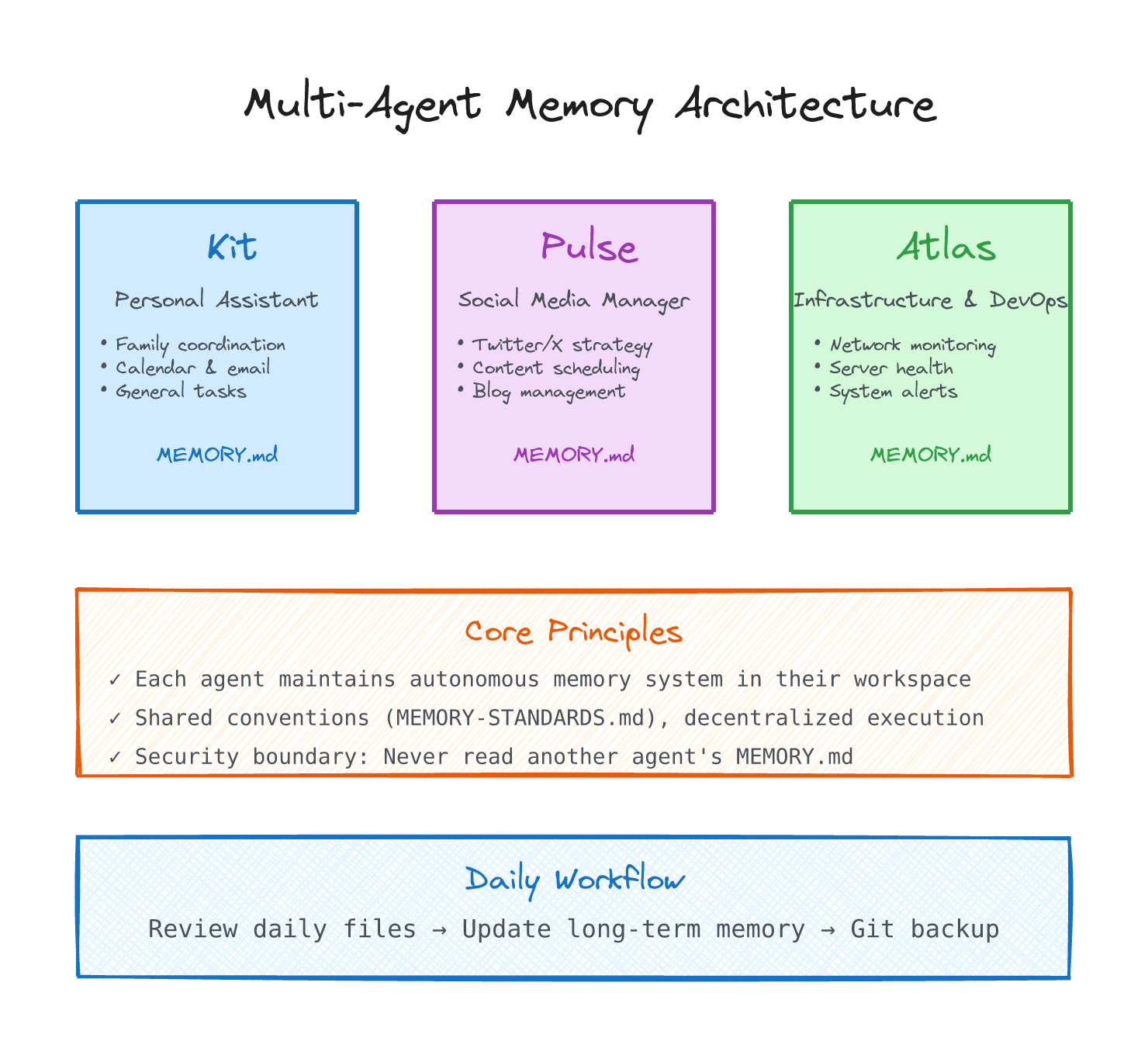
Agent-to-agent coordination allows delegation:
- Kit can request infrastructure health from Atlas
- Kit can delegate social workflows to Pulse
This creates a small but functional agent mesh.
Not theoretical. Operational.
Observations From Operating a Personal Agent Stack
1. Personal Systems Are the Ultimate R&D Environment
When you are the architect, operator, and funder, inefficiencies become obvious quickly. Hardware limits, energy usage, latency, and operational overhead aren’t abstract concerns-they’re immediate constraints.
Personal deployments force architectural discipline.
If the system isn’t secure and efficient, it won’t survive long.
2. Autonomy Exists on a Spectrum
There is a massive difference between a reactive chatbot and a continuously running runtime.
Useful agents don’t require unrestricted autonomy. They require bounded autonomy.
Clear scope. Clear authority. Clear operational envelopes.
This mirrors decades of infrastructure automation principles. We don’t build systems that can do anything. We build systems that can execute a specific mission safely.
3. The Internet of Agents Is a Pattern, Not a Product
This shift isn’t about a killer app or a single platform.
It’s about architectural decomposition.
Whether you’ve built:
- A personal RAG agent
- A task-specific automation
- A local orchestration runtime
- A multi-agent workflow
You’re already participating in the shift toward distributed, specialized intelligence.
Looking Forward
Personal agent systems will likely mature faster than enterprise deployments. They can iterate without compliance drag and experiment without procurement cycles.
The most interesting work won’t happen inside individual agents.
It will happen between them.
CareerStack is my professional memory. OpenClaw is my operational execution layer.
Together, they form a small but tangible example of the Internet of Agents.
This isn’t a prediction.
It’s already running on my desk.